
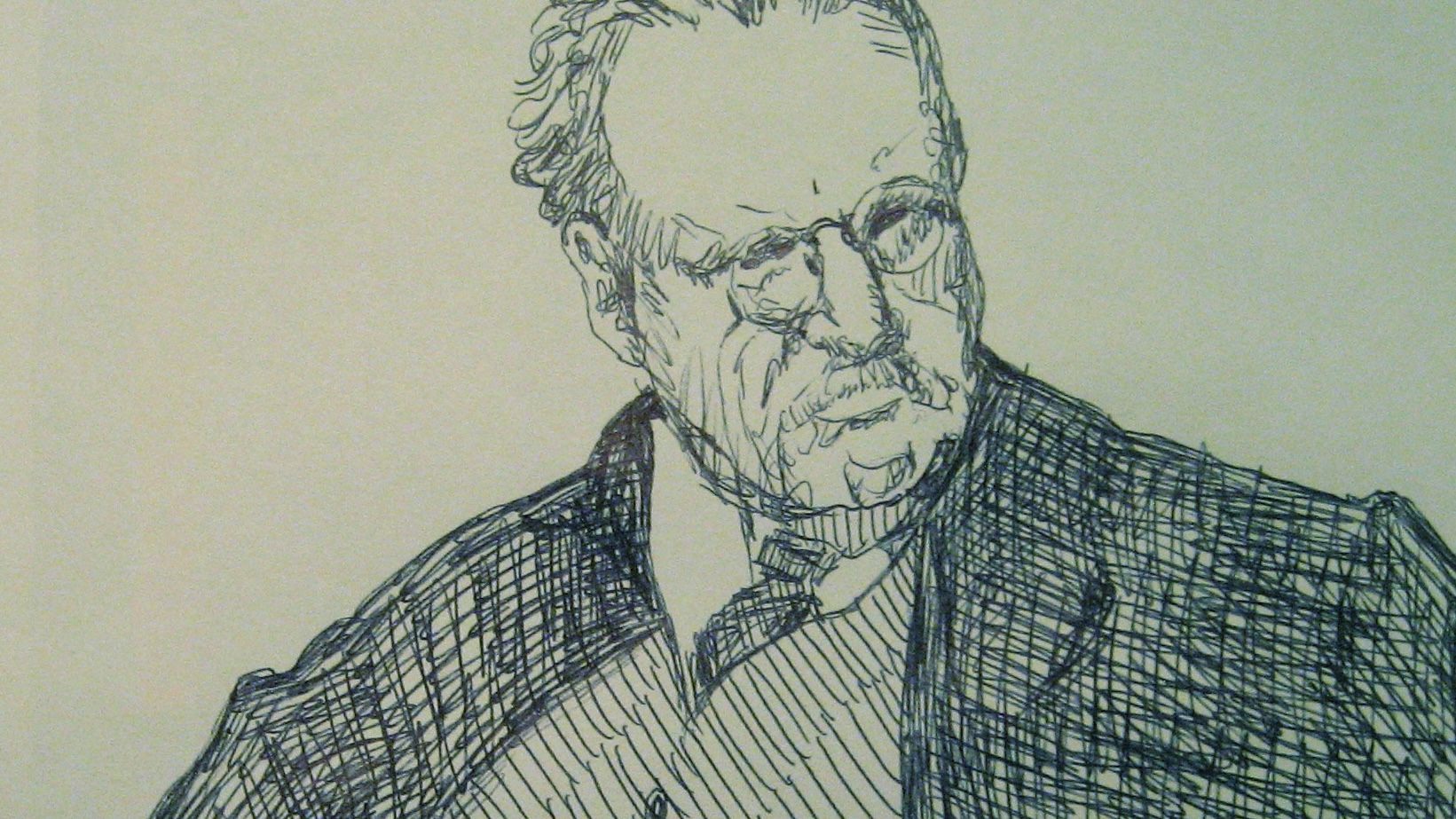
G. K. Chesterton’s book Orthodoxy has become a modern classic. According to Philip Yancey, “Chesterton managed to propound the Christian faith with as much wit, good humor, and sheer intellectual force as anyone in [the twentieth] century.”[1]
The following is a selection of passages from the book that I find encouraging and thought-provoking. They range from critiques of Enlightenment sensibilities to calls for humility to expressions of wonder at God’s creation and design. His candor and thoughtfulness are clear throughout the book, and these quotes are but a short glimpse of his voice—the kind of voice that can serve as a powerful witness in a post-Christian society.
Doubting Our Doubts
“In dealing with the arrogant asserter of doubt, it is not the right method to tell him to stop doubting. It is rather the right method to tell him to go on doubting, to doubt a little more, to doubt every day newer and wilder things in the universe, until at last, by some strange enlightenment, he may begin to doubt himself.”[2]
“The man should rule who does not think he can rule.”[3]
The Joy of Being Ordinary
“Oddities only strike ordinary people. Oddities do no strike odd people. This is why ordinary people have a much more exciting time; while odd people are always complaining of the dullness of life.”[4]
Offering “Oxygen” as an Apologetic for Christianity
“The strongest and most unmistakable mark of madness is this combination between a logical completeness and a spiritual contraction. The lunatic’s theory explains a large number of things, but it does not explain them in a large way. I mean that if you or I were dealing with a mind that was growing morbid, we should be chiefly concerned not so much to give it arguments as to give it air, to convince it that there was something cleaner and cooler outside the suffocation of a single argument.”[5]
On the Beauty of Being Small in Our Own Eyes
“How much larger your life would be if you self could become smaller in it.… You would break out of this tiny and tawdry theatre in which your own little plot is always being played, and you would find yourself under a freer sky, in a street full of splendid strangers.… How much happier you would be, how much more of you there would be, if the hammer of a higher God could smash your small cosmos, scattering the stars like spangles, and leave you in the open, free like other men to look up as well as down!”[6]
“If a man would make his world large, he must be always making himself small.”[7]
The Folly of Pride and Isolation
“Actors who can’t act believe in themselves; and debtors who won’t pay. It would be much truer to say that a man will certainly fail, because he believes in himself. Complete self-confidence is not merely a sin; complete self-confidence is a weakness.”[8]
“Thinking in isolation and with pride ends in being an idiot.”[9]
Mystery and Health
“Mysticism keeps men sane. As long as you have mystery you have health; when you destroy mystery you create morbidity.”[10]
A Magician Behind the Magic
“I had always believed that the world involved magic: now I thought that perhaps it involved a magician. And this pointed to a profound emotion always present and sub-conscious; that this world of ours has some purpose; and if there is a purpose, there is a person. I had always felt life first as a story: and if there is a story there is a story-teller.”[11]
“I felt in my bones … that this world does not explain itself.… I came to feel as if magic must have a meaning, and meaning must have someone to mean it.”[12]
Self-Centered Religion
“Of all horrible religions the most horrible is the worship of the god within.… That Jones shall worship the god within him turns out ultimately to mean that Jones shall worship Jones.”[13]
“Christianity came into the world firstly in order to assert with violence* that a man had not only to look inwards, but to look outwards, to behold with astonishment and enthusiasm a divine company and a divine captain.”[14]
* Note—Chesterton does not mean physical violence here; his point is that Christianity vehemently claims that humanity is to look outward to God in worship, not inward to the self.
“By insisting specially on the immanence of God we get introspection, self-isolation, quietism, social indifference—Tibet. By insisting specially on the transcendence of God we get wonder, curiosity, moral and political adventure, righteous indignation—Christendom. Insisting that God is inside man, man is always inside himself. By insisting that God transcends man, man has transcended himself.”[15]
True and False Notions of “Progress”
“The only intelligible sense that progress or advance can have among men, is that we have a definite vision, and that we wish to make the whole world like that vision.”[16]
“Now here comes in the whole collapse and huge blunder of our age. We have mixed up two different things, two opposite things. Progress should mean that we are always changing the world to suit the vision. Progress does mean (just now) that we are always changing the vision.… We are not altering the real to suit the ideal. We are altering the ideal: it is easier.”[17]
“As long as the vision of heaven is always changing, the vision of earth will be exactly the same. No ideal will remain long enough to be realized, or even partly realized. The modern young man will never change his environment; for he will always change his mind. This, therefore, is our first requirement about the ideal towards which progress is directed; it must be fixed.”[18]
“No political activity can be encouraged by saying that progress is natural and inevitable; that is not a reason for being active, but rather a reason for being lazy. If we are bound to improve, we need not trouble to improve. The pure doctrine of progress is the best of all reason for not being a progressive.”[19]
Naturalism Rooted in Dogma
“Somehow or other an extraordinary idea has arisen that the disbelievers in miracles consider them coldly and fairly, while believers in miracles accept them only in connection with some dogma. The fact is quite the other way. The believers in miracles accept them (rightly or wrongly) because they have evidence for them. The disbelievers in miracles deny them (rightly or wrongly) because they have a doctrine against them.”[20]
The Thrill and Wonder of Living Under Authority
“The very time when I was most under a woman’s authority, I was most full of flame and adventure. Exactly because when my mother said that ants bit they did bite, and because snow did come in winter (as she said); therefore the whole world was to me a fairyland of wonder fulfilments, and it was like living in some Hebraic age, when prophecy after prophecy came true. I went out as a child into the garden, and it was a terrible place to me, precisely because I had a clue to it: if I had held no clue it would not have been terrible, but tame. A mere unmeaning wilderness is not even impressive. But the garden of childhood was fascinating, exactly because everything had a fixed meaning which could be found out in its turn.”[21]
“[Modern philosophy] does not really believe that there is any meaning in the universe; therefore it cannot hope to find any romance; its romances will have no plots. A man cannot expect any adventures in the land of anarchy. But a man can expect any number of adventures if he goes traveling in the land of authority. One can find no meanings in a jungle of skepticism; but the man will find more and more meanings who walks through a forest of doctrine and design. Here everything has a story.”[22]
Christianity as Satisfying and Christ as Praiseworthy
“Christianity satisfies suddenly and perfectly man’s ancestral instinct for being the right way up; satisfies it supremely in this; that by its creed joy becomes something gigantic and sadness something special and small.”[23]
“Praise should be the permanent pulsation of the soul.”[24]
[1] G. K. Chesterton, Orthodoxy (Wheaton, IL: Harold Shaw), xiii.
[2] Chesterton, Orthodoxy, xii–xiii.
[3] Chesterton, Orthodoxy,127.
[4] Chesterton, Orthodoxy, 12.
[5] Chesterton, Orthodoxy, 16.
[6] Chesterton, Orthodoxy, 16–17.
[7] Chesterton, Orthodoxy, 29.
[8] Chesterton, Orthodoxy, 10.
[9] Chesterton, Orthodoxy, 41.
[10] Chesterton, Orthodoxy, 24.
[11] Chesterton, Orthodoxy, 61.
[12] Chesterton, Orthodoxy, 65–66.
[13] Chesterton, Orthodoxy, 78.
[14] Chesterton, Orthodoxy, 78.
[15] Chesterton, Orthodoxy, 145.
[16] Chesterton, Orthodoxy, 112.
[17] Chesterton, Orthodoxy, 113.
[18] Chesterton, Orthodoxy, 115.
[19] Chesterton, Orthodoxy, 118.
[20] Chesterton, Orthodoxy, 161.
[21] Chesterton, Orthodoxy, 167.
[22] Chesterton, Orthodoxy, 169.
[23] Chesterton, Orthodoxy, 171.
[24] Chesterton, Orthodoxy, 171.
“G.K. Chesterton” by giveawayboy, CC BY-NC-ND 2.0
